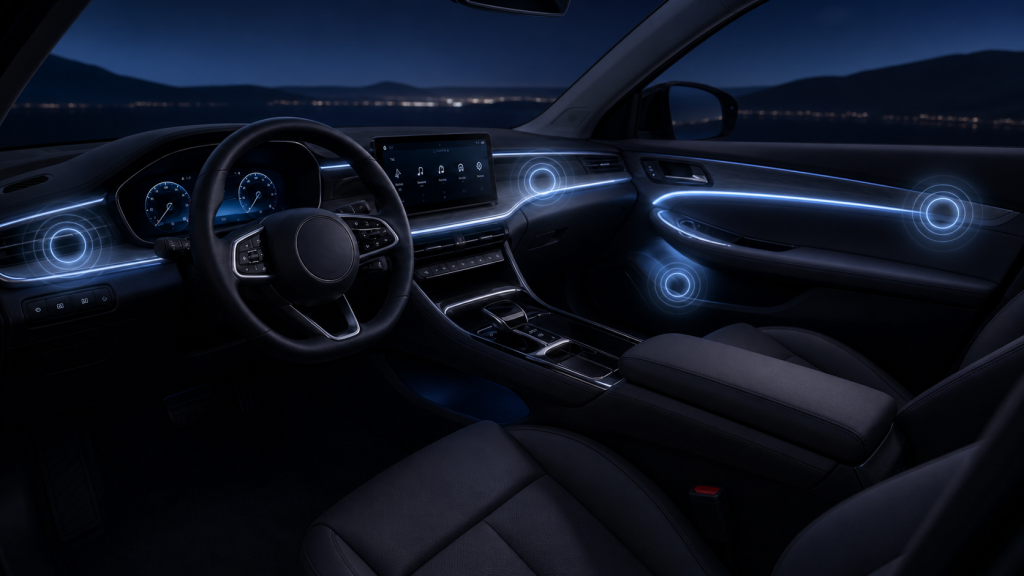
In an interior ambient lighting project, dynamic effects are not just visual decoration. For project engineers, they need to be defined together with cabin scenarios, trigger signals, control logic, and lighting zones.
Two common dynamic effects are flowing light and breathing light. Both can improve the cabin experience, but they are suitable for different use cases.
Flowing Light: For Action-Based Scenarios
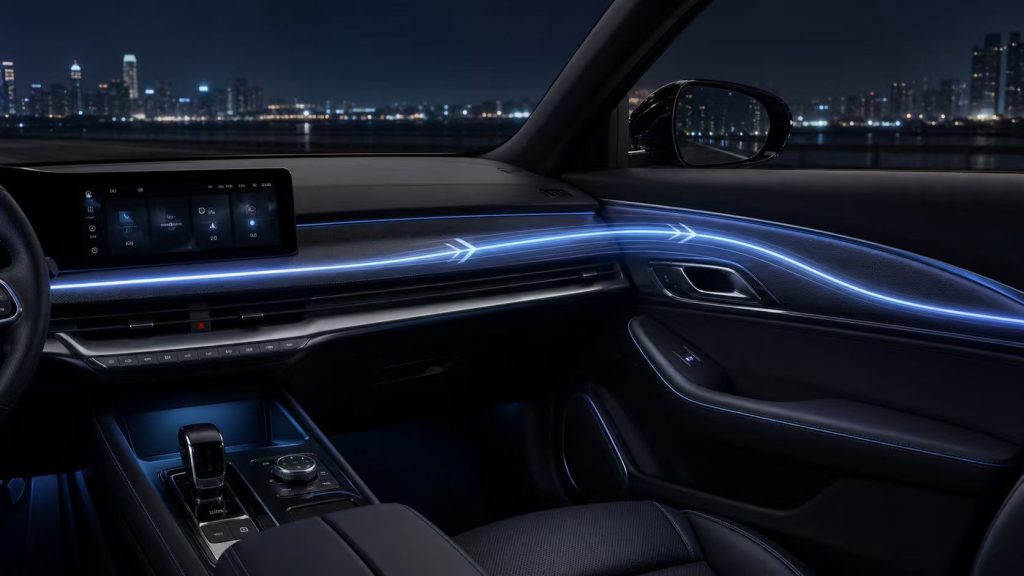
A flowing light effect creates a continuous movement along a light guide, trim line, door panel, or dashboard area. The light appears to move from one zone to another, creating a clear visual transition.
It is suitable for scenarios with a defined trigger event, such as:
- Welcome sequences after vehicle unlocking
- Startup animations when the vehicle powers on
- Door opening or cabin entry guidance
- Driving mode switching
- Multi-zone lighting interaction
The purpose of flowing light is to express an action or transition. During project definition, engineers need to confirm the trigger signal, starting zone, flowing direction, animation duration, and coordination between different lighting areas.
Breathing Light: For Status-Based Scenarios
A breathing light effect gradually increases and decreases brightness at a controlled rhythm. It does not emphasize spatial movement, but creates a soft and low-interruption lighting state.
It is suitable for scenarios such as:
- Parking or standby mode
- Comfort or relaxation cabin modes
- Low-brightness night ambient lighting
- Non-urgent status indication
- Subtle interaction without distracting the driver
For breathing light, the key points are brightness range and rhythm control. If the cycle is too fast, it may feel restless. If the brightness is too strong, it may become distracting. If it is too weak, the effect may not be clearly perceived.
How to Choose
A simple way to decide is:
If the lighting effect needs to show that an action is happening, flowing light is usually the better choice.
If the lighting effect needs to show that the cabin is in a certain state, breathing light is usually more suitable.
In real vehicle projects, both effects can be used in the same ambient lighting system. For example, flowing light can be used for welcome and startup sequences, while breathing light can be used for parking, standby, or comfort modes.
The key is to define the relationship between scenario, signal, lighting effect, and lighting zone early in the project.
KEPO Interior Ambient Lighting Solutions
KEPO supports interior ambient lighting solutions for door panels, dashboards, welcome lighting, decorative trim lighting, and other customized cabin lighting modules.
For dynamic effects such as flowing light and breathing light, KEPO can support lighting zone definition, effect implementation, component development, and system integration based on project requirements, helping engineering teams turn cabin lighting concepts into feasible and verifiable solutions.