The automotive seat has remained functionally unchanged for decades. It supports. It adjusts. It occasionally heats or cools. What it hasn’t done — until recently — is communicate.
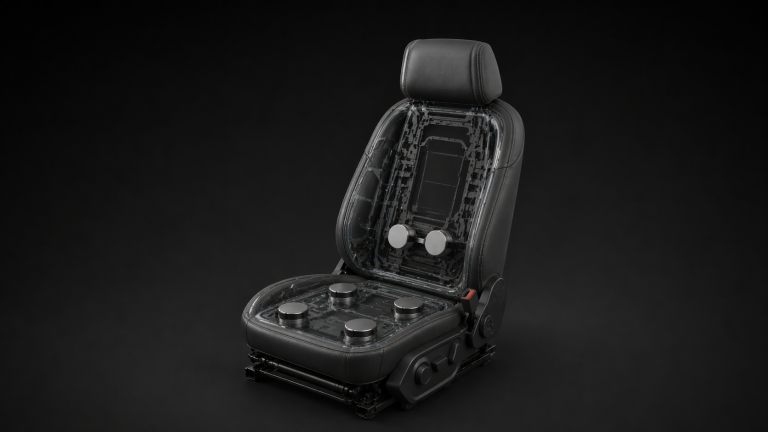
That’s the premise behind KEPO 4D Exciter: a haptic actuator system that transforms the seat from a passive surface into an active interface between the vehicle and its occupants.
What It Does
At its core, 4D Exciter converts electronic signals into precisely calibrated physical vibration. The actuator is embedded in the seat structure and responds in milliseconds to inputs from the vehicle’s sensor and software layer. What makes it useful isn’t the vibration itself — it’s what that vibration can be made to mean.
Three Use Cases That Matter
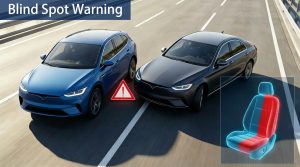
Safety alerts. When a Driver Monitoring System detects distraction — phone use, gaze deviation, head orientation shift — the seat responds immediately. No chime, no screen notification. A targeted haptic pulse reaches the driver through touch, bypassing the visual and auditory channels that are already competing for attention. The alert is instant, non-intrusive, and closed-loop with DMS and ADAS outputs.
Music rhythm. The same hardware reads audio frequency and rhythm in real time, translating low, mid, and high register into differentiated haptic output. The result is music you feel as well as hear — synchronized to the millisecond, not approximated. This extends naturally to rear-seat passengers, giving them an immersive experience independent of where they’re seated.
Seat massage. Drawing on TCM meridian principles and ergonomic research, 4D Exciter delivers structured haptic patterns designed for muscle relief during extended driving. The patterns are calibrated for effect — not background noise, but targeted intervention at the points where tension accumulates over long journeys.
One Module, Multiple Roles
What distinguishes 4D Exciter architecturally is that all three use cases run on a single integrated module. For OEM teams, this means one integration point, one certification process, and a hardware investment that scales across applications.
As cabin differentiation increasingly happens at the software and experience layer, haptic architecture is becoming a relevant variable earlier in the development cycle. The seat that communicates — alerts, entertains, and recovers — is a different product category from the seat that doesn’t.